
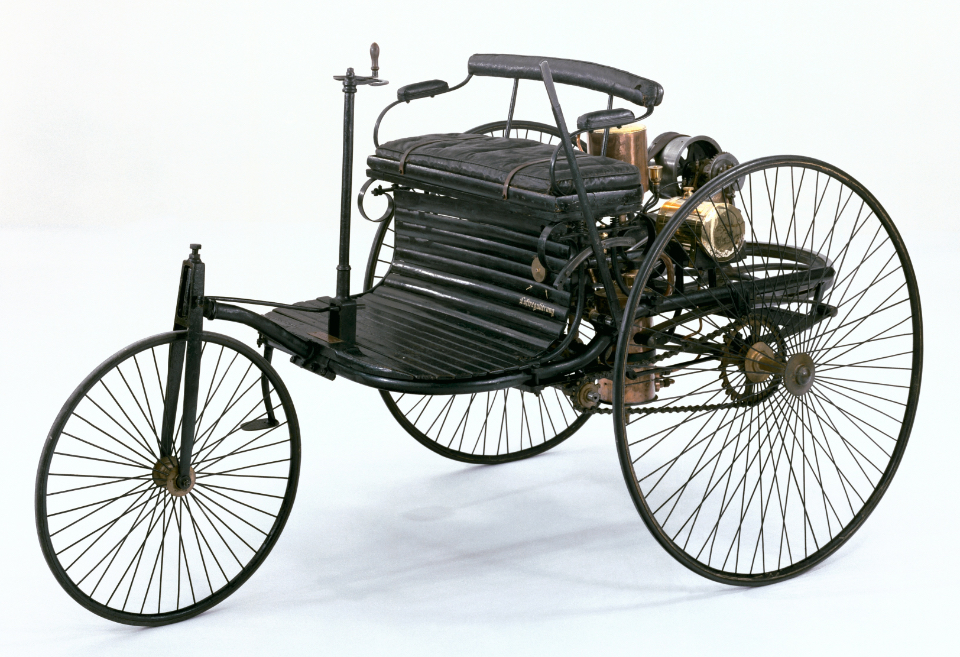
 Benz 1886 Foto Deutsches Museum
 An icon of automotive history turns 140
Since Carl Benz registered his patent for the motor car (Motorwagen) in 1886 and Gottlieb Daimler built his motorised carriage (Motorkutsche) shortly afterwards, the history of Mercedes-Benz has for 140 years known only one direction: forward. From Bertha Benz’s legendary pioneering journey to speed records, early milestones in autonomous driving, vision cars and high-tech drive systems: the brand is constantly rethinking the automobile.
The first functional automobile with a combustion engine:
On January 29, 1886, Carl Benz registered the patent for his motor car.
The performance data is not particularly impressive: it delivered less than one horsepower to its narrow wheels, and its top speed was closer to 12 than 16 km/h, but it consumed ten liters of gasoline per 100 kilometers. And it didn’t look like a car, but rather a cross between a bicycle and a carriage. Nevertheless, the Benz motor car was a revolution: it is considered the first truly functional automobile with a combustion engine – an icon of automotive history. And this year marks its 140th birthday.
The Benz motor car is celebrating a double anniversary this year: On January 29, 1886, exactly 140 years ago, engineer Carl Benz (1844–1929) registered the patent for his “gas-powered vehicle” with the Imperial Patent Office – the patent is thus something like the birth certificate of the automobile. Twenty years later, on March 13, 1906, the car arrived at the Deutsches Museum. Today, it is on display at the Verkehrszentrum (Transportation Center) on Theresienhöhe: “This is an exhibit that many other museums envy us for,” says Bettina Gundler, director of the Verkehrszentrum.
Installing an engine in a vehicle – today, that sounds like a trivial task. Back then, it was not. Small, powerful engines suitable for mobile use simply did not exist yet. Just think of the first diesel engine from 1896, which is also in the collection of the Deutsches Museum. It weighs almost six tons and was not intended as a drive for a ship or truck, but as a steam engine replacement for a factory.
So an extra drive had to be built for a car – and that is Carl Benz’s real achievement: he designed a small, water-cooled, fast-running gasoline engine weighing a good 100 kilograms. The engine had a displacement of almost one liter, only one cylinder, and was powered by gasoline. Mind you, not with the gasoline we use today, but with light gasoline from the pharmacy. There were no gas stations yet. Nor was there an ignition key: the motor car was started by turning the rear flywheel with a vigorous twist. And it didn’t have pedals either: the drive and brake levers were located to the left of the seat. The vehicle was not easy to drive, says Bettina Gundler: “Because of the ‘rear engine,’ the car was much heavier at the back than at the front, so the front wheel bounced up and down on bumpy roads.”
When designing the car, Benz, himself a cyclist, also used parts from bicycle construction. He sourced them directly from Adler, a well-known bicycle manufacturer. Bettina Gundler: “Benz also had to spend a lot of time on the electric ignition: he tested various ignition mechanisms – in the end, a so-called buzzer ignition was used in his patented car.” The car was very light overall, weighing only 265 kilograms without passengers.
However, the rewards for his inventive work were meager: there was no market for cars yet. “People tended to be frightened when they saw and heard such a vehicle,” says Bettina Gundler. Benz motor cars initially enjoyed their greatest success in France, which at that time was becoming a pioneer of the automotive community in Europe through sporting events. In 1889, Benz traveled to the Paris World’s Fair and presented his patented car and engines, which attracted a lot of attention there.
Berta Benz, Benz’s wife, also played a part in this success. In 1888, she set off with her sons on their first “long-distance trip” from Mannheim to Pforzheim – without telling her husband. It was no leisurely drive: the three had great difficulty obtaining gasoline and keeping the vehicle running. But in the end, they covered the nearly 100 km route and, in doing so, proved the basic functionality of Benz’s three-wheelers. Nevertheless, very few examples of the three-wheeler were built. Initially, there was no demand for it in Germany. It was only via France that Benz found more buyers for his “patent motor car” in the mid-1890s. He had improved his vehicles in the meantime. From 1893 onwards, Benz vehicles were equipped with axle pivot steering and now had four wheels.
At that time, it was not yet clear that gasoline-powered cars would emerge victorious in the technological competition of the 20th century: there were also steam-powered cars and, after 1900, a small boom in electric cars. But Benz stayed on the ball. “His company became the nucleus of the German automotive industry,” says Bettina Gundler.
And how did the Patent Motor Car later end up in the Deutsches Museum? And is the car actually an original? Bettina Gundler has also addressed this question. After the last test drives, the Benz Patent Motor Car No. 1 was dismantled. The engine is said to have continued to be used as a stationary power machine in Benz’s workshop. In 1895, the car was reassembled. “It is difficult to reconstruct today which parts may have been replaced in the workshop at that time,” says Gundler. At least the engine is considered to be original. The car was shown at exhibitions in 1905, most recently in Chicago. In 1906, the inventor and Benz AG donated the car to the recently founded Deutsches Museum. It has been on permanent display there since 1911. In 1925, one of Carl Benz’s last trips took him to Munich, where he visited the Deutsches Museum and was personally guided through the exhibitions by Oskar von Miller.
Incidentally, you can still buy a Benz motor car today – a replica, of course. However, the car costs around 150,000 euros as a “new replica” and is not street legal. Just like in 1886. Until 1894, Benz needed official permission for each individual trip he took.
Technical data of the Benz motor car
- Engine: 1-cylinder four-stroke engine
- Displacement: 984 cc
- Power: 0.66 kW (0.88 hp)
- Top speed: 16 km/h in theory, but probably closer to 12 km/h in reality
- Weight: 265 kg
- Fuel consumption: around 10 liters per 100 kilometers